Too Odd to Belong, Too Driven to Stop: The Outcast Who Organized Every Library in America
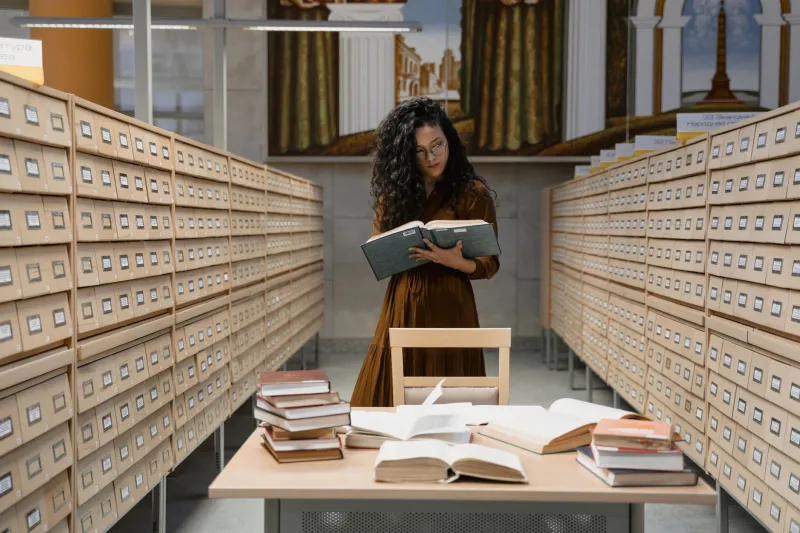
There's a number on the spine of almost every book in every public library in America. It tells you exactly where the book lives — which shelf, which section, which neighborhood of human knowledge it belongs to. Most people don't think about where that number came from. It came from a twenty-five-year-old farm boy from Adams Center, New York, who was considered by nearly everyone around him to be somewhere between eccentric and impossible.
His name was Melvil Dewey. He invented a system that organized the world's knowledge. Then the world, somewhat predictably, decided it didn't have room for him.
 Photo: Melvil Dewey, via i.ytimg.com
The Boy Who Couldn't Stop Counting
Dewey was born in 1851 in rural upstate New York, the son of a shopkeeper. From early childhood, he displayed the kind of obsessive focus on efficiency and order that adults tend to find either impressive or alarming, depending on their tolerance for being told they're doing things wrong.
He was doing things wrong constantly, in Dewey's view. Spelling was inefficient. Time management was inefficient. The way people organized information was catastrophically, almost offensively inefficient. Dewey spent a significant portion of his youth devising systems to fix all of it.
He enrolled at Amherst College in Massachusetts, where he worked part-time in the college library to help cover his costs. It was there, in 1873, that the problem he'd been born to solve came fully into focus.
 Photo: Amherst College, via m.media-amazon.com
The library's books were organized by the order in which they'd been acquired — essentially, by accident. Finding anything required either luck or an intimate familiarity with the collection. For a mind like Dewey's, this was not a minor inconvenience. It was an emergency.
The System Built on a Sunday
The story Dewey told later — and he told it often, because he understood its mythological appeal — was that the solution came to him during a long church service in January 1876. His mind, freed from the obligation of paying attention to the sermon, wandered into the problem of library classification and emerged, sometime around the second hymn, with the skeleton of what would become the Dewey Decimal System.
The reality was somewhat less cinematic. The system took months of refinement. Dewey borrowed heavily from existing classification frameworks, a fact that would later generate accusations of intellectual appropriation. But the synthesis he produced was genuinely new in its scope and ambition: a universal numerical system that could accommodate every subject of human inquiry, organized hierarchically, and scalable to any size of collection.
He published it in 1876, the same year he helped found the American Library Association. He was twenty-five years old.
The timing was, in retrospect, almost absurdly perfect. America was on the verge of a public library explosion. Andrew Carnegie's philanthropic campaign to fund library buildings across the country would eventually produce more than 2,500 structures. Every one of those buildings needed a way to organize its contents. Dewey had just provided it.
The Institutions That Couldn't Contain Him
Here's where the story gets complicated, as stories about difficult geniuses usually do.
Dewey was, by most accounts, genuinely hard to work with. He was domineering, impatient with anyone who didn't share his urgency about efficiency, and possessed of a certainty about his own rightness that wore thin quickly. He also had a habit of crossing personal boundaries with women colleagues and employees — a pattern that would eventually become the instrument of his professional destruction.
He founded the first professional library school in the country at Columbia University in 1887. Columbia forced him out within two years, citing his admission of women to the program — an irony that says more about Columbia than it does about Dewey. He moved the school to Albany, where he served as New York State Librarian for over a decade, building one of the most innovative state library systems in the country.
Albany eventually forced him out too, this time over the harassment complaints that had followed him throughout his career. He retreated to the Adirondacks, where he'd built a private resort called Lake Placid Club — a place that was, among other things, explicitly segregated, a stain on his legacy that no amount of institutional achievement can fully wash out.
 Photo: Lake Placid Club, via a.cdn-hotels.com
The System That Outlived the Man
By the time Dewey died in 1931, he had been effectively expelled from the professional world he'd done more than almost anyone to create. The American Library Association, which he'd helped found, had distanced itself from him. The institutions that used his system daily rarely mentioned his name.
And yet the system itself was everywhere. It had been adopted by libraries across the United States and eventually around the world. It had been translated into dozens of languages. It had been revised and expanded through twenty-three editions. It had done exactly what Dewey designed it to do: given every library, regardless of size or location or resources, a shared framework for making knowledge findable.
The uncomfortable arithmetic of Dewey's legacy is this: a man who was deemed too difficult, too abrasive, and ultimately too compromised to participate in polite professional society built the infrastructure that made mass public education possible in America. His system sat at the intersection of Carnegie's money and the public's hunger for knowledge, providing the organizational logic without which thousands of new libraries would have been rooms full of books that nobody could find.
The Long Odds of the Outsider
What makes Dewey's story resonate for this particular club is the specific shape of his exclusion. He wasn't kept out because he lacked talent or vision. He was kept out — repeatedly, definitively — because he didn't fit. Too strange, too driven, too unwilling to moderate himself for the comfort of institutions that were, in some cases, using his own ideas to justify their authority.
The system he built survived all of it. It survived his personal failings, his professional exile, and a century of technological change that has transformed nearly every other aspect of how humans find information.
Next time you're standing in a library, looking at the numbers on the spines, you're looking at the work of a farm boy from upstate New York who was considered too odd to belong anywhere.
He organized the whole country's knowledge anyway.