Thrown Out at Seventeen, Back at Forty — The Exile Who Taught Millions of Americans to Read
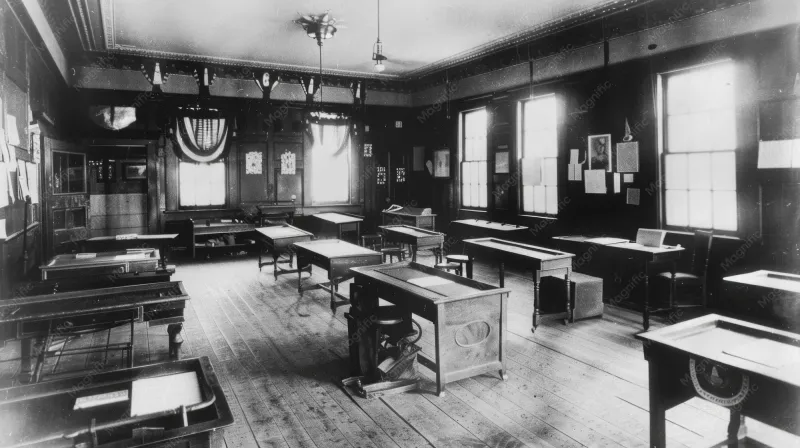
Photo: vintage adult literacy classroom early 20th century immigrants learning, via img.freepik.com
The Deportation That Made Him
He didn't leave voluntarily. That's the part of the story that tends to get softened in retrospect, the way uncomfortable origins have a habit of getting smoothed out once someone becomes worth celebrating. He was removed. Formally, officially, with the full bureaucratic weight of an immigration system that had decided he was not the kind of person the country wanted to keep.
He was seventeen. He had been in America long enough to develop a fierce, complicated attachment to it — the way immigrants often do, loving a country harder than people born into it because they've had to choose it rather than simply inherit it. Being expelled from that country was not just a legal event. It was a rupture.
He carried it for decades. And it changed the way he saw everything.
What Exile Teaches You About the Place You Left
There is a particular kind of clarity that comes from being outside a system looking in. Insiders develop blind spots — not out of stupidity, but out of familiarity. When something has always worked a certain way, it becomes nearly impossible to imagine it working differently. The assumptions become invisible because they're everywhere.
He didn't have that problem. He had been removed from the American system before it had a chance to fully absorb him, and so he could see it the way a traveler sees a city they've only visited — with attention, with curiosity, and without the accumulated habit of taking it for granted.
What he saw, from a distance of an ocean and then another continent, was a country that was failing enormous numbers of its own people on the question of basic literacy. Not because Americans were unintelligent. Not because the will wasn't there. But because the methods being used were designed for children sitting in classrooms, and most of the people who needed to learn to read were adults who worked twelve-hour days and had never been inside a classroom in their lives.
The education system wasn't reaching them. It wasn't even trying, particularly. The assumption, unspoken and pervasive, was that if you'd reached adulthood without learning to read, that was more or less your problem.
He thought that was wrong. And he spent his years of exile figuring out what to do about it.
The Education He Built for Himself
The countries he passed through during his exile were not, on the surface, obvious classrooms. He worked. He moved. He spent time in places where formal education was structured very differently than in America, where the relationship between a teacher and a learner was built on different assumptions about who was capable of what.
He paid attention. He read everything he could get his hands on — educational theory, linguistics, the nascent science of how adults acquire language differently from children. He corresponded with teachers and reformers in Europe who were experimenting with methods that the American mainstream hadn't encountered yet. He was building, piece by piece, a framework for something he couldn't fully articulate until he had the chance to test it.
The testing came later. First, he had to get back in.
The Return
He was in his late thirties or early forties when he finally managed to return to the United States — the records, depending on which archive you consult, place the date within a range of a few years. He came back different. Not broken, which is what the people who had expelled him might have expected, but sharpened. The exile had given him time and distance and the particular motivation that comes from having something to prove to a country that told you it didn't want you.
He started small. A room, some borrowed chairs, a handful of adults who had heard through word of mouth that someone was teaching reading in a way that actually worked for people like them. Working-class men and women, mostly. Recent immigrants who had never been offered the tools to navigate the country they'd moved to. People who had been told, explicitly or implicitly, that the window for learning had closed.
He told them it hadn't. And then he showed them.
Why the Outsider Saw What the Insiders Missed
The methods he developed weren't magic. They were, in retrospect, fairly logical — built on the observation that adults learn differently from children, that motivation matters enormously, that connecting reading to the immediate practical needs of the learner produces faster and more durable results than abstract drills.
But logic and obviousness are not the same thing, and in the world of American education at the time, these ideas were genuinely countercultural. The established institutions had invested heavily in a particular model. Suggesting that the model wasn't working for a significant portion of the population was not a neutral observation — it was a challenge to the people whose careers and reputations were built on that model.
He could make that challenge because he had no stake in the existing system. He hadn't been trained by it, hadn't been rewarded by it, hadn't built relationships within it that he needed to protect. He was, in the most literal sense, an outsider. And his outsider's eye saw the gap between what the system claimed to do and what it was actually accomplishing.
The reach of his literacy programs, at their peak, extended to hundreds of thousands of working-class Americans across multiple cities. The methods he pioneered influenced a generation of adult educators who came after him, many of whom had no idea where the ideas originally came from.
The Country That Expelled Him, Taught by Him
There is something almost poetic about the arc of it. A teenager, deemed unworthy of remaining in the country, spends twenty years developing the exact expertise that country most needs. Returns. Quietly, methodically, without fanfare, begins filling a gap that the official system couldn't see because it was too close to its own assumptions.
He never got a government appointment. He never ran a major institution. The recognition he received in his lifetime was modest and local, the kind that doesn't make it into the history books.
But the people who learned to read because of him — the factory worker who could finally read his own pay stub, the immigrant mother who could help her children with their schoolwork, the man in his fifties who had been ashamed of his illiteracy for decades and finally wasn't — those people carried what he gave them for the rest of their lives.
The long odds, for him, ran from a deportation order to a literacy movement. He made the most of every mile.