The Man With a Mop Who Changed How Surgeons Think About Germs
The Lowest Rung on the Ladder Had the Best View
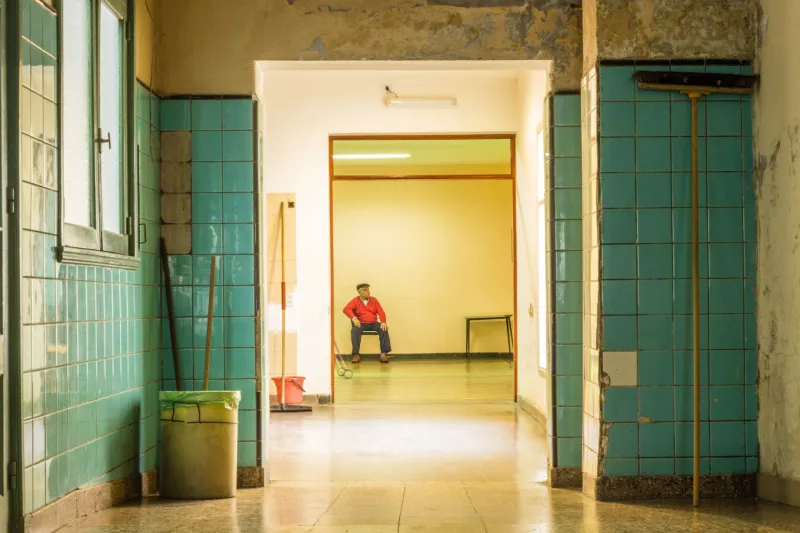
There's a particular kind of invisibility that comes with wearing a custodial uniform inside a hospital. Doctors look through you. Nurses step around you. The assumption — unspoken but iron-clad — is that the person pushing the mop is there to clean up after the real work is done, not to contribute to it.
For most of the mid-twentieth century, that assumption went unquestioned in American hospitals. But in the corridors of a regional surgical center in the industrial Midwest, one custodian was paying attention in ways that nobody else was — and what he noticed would eventually save lives by the thousands.
His name was Joseph Moran. He had no medical degree, no nursing license, no letters after his name. What he had was time, proximity, and a mind that couldn't stop asking why.
Patterns Nobody Else Was Looking For
Moran had started as an operating room custodian in the early 1950s, a job he took out of necessity after a factory layoff. The work was demanding and largely thankless — sterilizing surfaces, disposing of surgical waste, scrubbing floors between procedures. But Moran was methodical by nature, and over months of repetitive work, he began to notice something that troubled him.
Certain operating rooms had dramatically higher rates of post-surgical infection than others. Not slightly higher — dramatically. And the pattern didn't track with the complexity of the surgeries being performed, or the experience of the surgeons. It tracked with location. With airflow. With the sequence in which rooms were used throughout the day.
Moran started keeping notes. On scraps of paper, in a logbook he bought himself, he catalogued which rooms saw which procedures, how long rooms sat unused between surgeries, where the ventilation ducts were positioned, which surfaces he cleaned in which order. He was constructing, without any formal training, something that looked remarkably like an epidemiological study.
"He wasn't doing science the way scientists do it," a hospital administrator would later recall. "He was doing it the way a very observant human being does it — by refusing to accept that coincidence explains everything."
The Memo Nobody Wanted to Read
In 1958, Moran did something that took considerable courage for a man in his position: he wrote a memo. Two pages, handwritten, addressed to the hospital's chief of surgery. In it, he laid out his observations — the room correlations, the airflow patterns, the timing data — and suggested that the hospital's sterilization protocols might be creating contamination risks that the surgical team hadn't considered.
The response was roughly what you'd expect. The chief of surgery sent back a polite but dismissive reply. A department head reportedly joked about it in the break room. The memo was filed somewhere and forgotten.
But Moran didn't stop. He refined his notes, sought out whatever medical literature he could find in the public library, and eventually connected with a young hospital administrator named Ruth Cassidy, who was one of the few people in the building willing to listen to someone who cleaned floors for a living.
Cassidy brought Moran's findings to a public health researcher at a nearby university. That researcher — initially skeptical — spent three months reviewing Moran's data and came away shaken. The patterns were real. The correlations were statistically significant. And the mechanism Moran had identified, contaminated air circulating from adjacent rooms during high-traffic surgical windows, was something the existing literature had barely touched.
Vindication Arrives Quietly
The academic paper that followed listed the researcher and Cassidy as authors. Moran's name appeared in the acknowledgments — a single line near the bottom. But the findings themselves, which recommended sweeping changes to operating room ventilation protocols and sterilization sequencing, were adopted by hospital accreditation bodies within the decade.
Those changes are now standard practice across American hospitals. The protocols governing how surgical suites are cleaned, aired, and sequenced between procedures trace a direct line back to observations first recorded in a custodian's personal logbook.
Moran never received formal recognition during his lifetime. He retired in 1971 and died in 1984. A small plaque was installed in the hospital's administrative corridor in the 1990s — the kind of thing most visitors walk past without reading.
What the Mop Saw That the Scalpel Missed
The Moran story isn't really about one man's ingenuity, though that's remarkable enough. It's about what happens when institutions assume that knowledge has a dress code.
The irony is layered: the people closest to the problem — the ones who spent the most time in operating rooms, who knew every corner and duct and surface — were the last ones consulted. The hierarchy of expertise that governs hospitals is necessary in most respects. But it has a blind spot, and that blind spot is the assumption that insight only flows downward.
Moran spent years in spaces where some of the country's best surgical minds worked. He watched, he recorded, he reasoned. He didn't have the vocabulary of medicine, but he had something just as valuable: the freedom to notice things without the cognitive bias of formal training telling him what should matter.
There's a lesson in that for anyone who's ever been told their perspective doesn't count because of where they sit in an org chart. The long odds don't just apply to the people who eventually get credit. They apply to the ideas themselves — the ones that have to fight their way up from the basement to the boardroom before anyone takes them seriously.
Joseph Moran's idea made it. It just took a while. And it cost more lives than it should have that it took that long.