
The Boy They Called an Idiot
In 1849, when Tom Wiggins was born on a Georgia plantation, three strikes were already against him. He was Black in antebellum America. He was blind from birth. And he displayed behaviors that his era dismissed as "idiocy"—what we'd now recognize as autism spectrum traits.
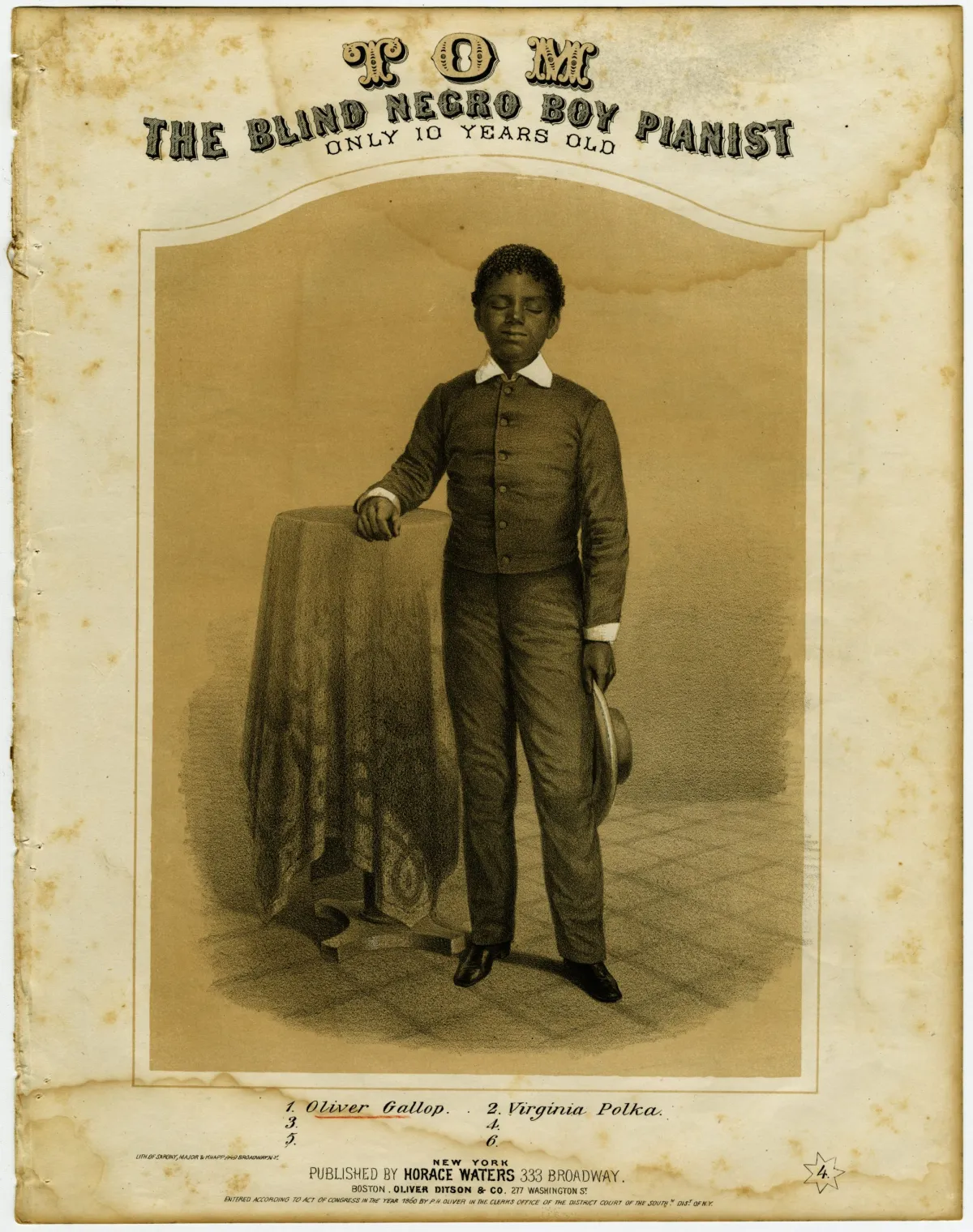 Photo: Tom Wiggins, via klinkharthall.org
Most enslaved children in his condition didn't survive past infancy. Tom not only survived—he would go on to earn more money than any other performer of his generation, Black or white.
But first, he had to convince the world he was worth nothing at all.
The Discovery That Changed Everything
When Tom was four years old, his owner's daughter was practicing piano in the main house. From the slave quarters, a strange sound drifted back—the same melody, note for note, being played on an imaginary keyboard.
Tom's fingers were dancing across a wooden plank, reproducing every nuance of the piece he'd just heard. When they brought him to the actual piano, something extraordinary happened: he played the entire composition flawlessly, despite never having touched the instrument before.
This wasn't just musical talent. This was something the 19th century had no framework to understand. Tom could hear a piece of music once—any piece, no matter how complex—and reproduce it perfectly. He could play classical compositions, popular songs, even random sounds like thunderstorms or train whistles.
The Exploitation Begins
Tom's owner, James Bethune, quickly realized he'd stumbled onto something unprecedented. But this was 1853, and a enslaved person with extraordinary abilities presented a peculiar problem. How do you profit from genius when the law says that genius is your property?
Bethune's solution was brilliant and cruel: market Tom not as a musician, but as a curiosity. A "musical marvel" whose abilities were so inexplicable they must be supernatural. The promotional materials called him an "idiot savant"—a term that let audiences marvel at his talent while maintaining their assumptions about Black intelligence.
The strategy worked perfectly. Tom began touring as "Blind Tom," drawing massive crowds who came to gawk at the "musical automaton." They expected a sideshow. What they got was artistry that left them speechless.
Carnegie Hall and the Con That Wasn't
By 1866, Tom was performing at Carnegie Hall—still technically enslaved, though the Civil War had officially ended slavery. The audiences came expecting a freak show and left having witnessed one of the finest musical performances of their lives.
 Photo: Carnegie Hall, via wallpapers.com
Here's where Tom's story takes an unexpected turn. While everyone assumed he was simply a vessel for inexplicable musical reproduction, Tom was actually composing. Original pieces. Complex, emotionally sophisticated works that revealed a musical mind operating at the highest levels.
He had been hiding his true abilities behind the mask of the "idiot savant." Let them think he was a musical parrot, he seemed to calculate. It was safer that way.
The Financial Genius Nobody Recognized
By the 1870s, Tom was the highest-paid performer in America, earning more than $100,000 annually—equivalent to millions today. But here's the remarkable part: despite being legally considered property for much of his career, Tom had quietly developed an understanding of his own market value.
When various parties fought over the rights to his performances after the Civil War, Tom displayed a shrewd grasp of contract negotiations. He knew exactly how much revenue he generated and fought for a larger share. This from a man the world insisted was mentally deficient.
The Legacy They Tried to Erase
Tom Wiggins performed for presidents, sold out venues across three continents, and composed pieces that are still performed today. Yet for decades after his death in 1908, music historians largely ignored his contributions.
Why? Because acknowledging Tom's genius required admitting that 19th-century America had fundamentally misunderstood both disability and race. Tom succeeded not because he was a musical automaton, but because he was a sophisticated artist who understood that survival sometimes requires letting people underestimate you.
The Real Con
The greatest deception in Tom's story wasn't that he fooled his way into Carnegie Hall. It's that an entire nation convinced itself that extraordinary talent could emerge from someone they'd categorized as subhuman—and still managed to avoid questioning their categories.
Tom Wiggins earned the right to stay at Carnegie Hall the moment he first sat down at a piano. The tragedy is that he had to pretend to be less than he was to claim that right.
Today, as we reckon with how society treats both disability and artistic genius, Tom's story feels less like a historical curiosity and more like a master class in navigating systems designed to exclude you. Sometimes the longest odds aren't just about overcoming barriers—they're about convincing the world that the barriers were never real in the first place.