She Walked Into a Prison Classroom With No Plan. What Came Out Changed How America Reads.
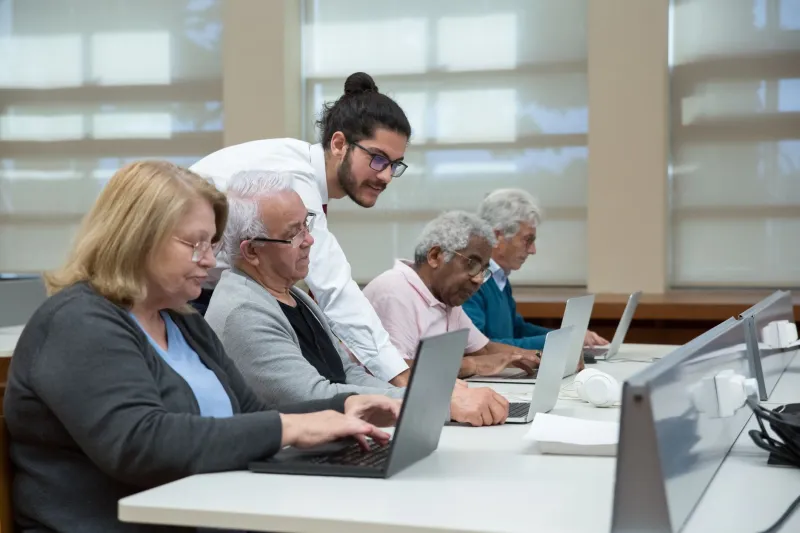
The first class Darlene Okafor ever taught had eleven students, one broken overhead projector, and no textbooks. The classroom was inside a medium-security correctional facility in rural Georgia. Darlene was a 31-year-old volunteer with a background in retail management and exactly zero formal training in education.
She had signed up because a flyer at her church asked for literacy tutors and she had a free Saturday. That was the full extent of her plan.
What happened in that room over the next several months — and what eventually grew out of it — is one of those stories that makes you reconsider where good ideas actually come from. Spoiler: it's rarely from the people with the most credentials.
The Problem Nobody Wanted to Own
America has a literacy crisis that tends to get discussed in the abstract and ignored in the specific. The numbers are striking — roughly 54 percent of American adults read below a sixth-grade level, according to research from the National Center for Education Statistics. Inside correctional facilities, that number climbs significantly higher. Most literacy programs designed for incarcerated adults are adaptations of curricula built for children, and they tend to produce the same result: incremental progress followed by disengagement.
Darlene didn't know any of this when she walked in. She just knew that the standard workbooks she'd been handed by the program coordinator weren't working. Students were shutting down. The material was condescending. The pacing was wrong. And the whole framework seemed designed around shame — around identifying what people couldn't do rather than building on what they already understood.
So she threw out the workbook after the third session and started improvising.
Building a Method From Scratch
What Darlene developed over the following two years wasn't born from pedagogical theory. It came from watching people closely and asking a lot of questions. She noticed that her students could decode spoken language with tremendous sophistication — they tracked narrative, caught nuance, followed complex arguments in conversation. The issue wasn't comprehension. It was the specific mechanical disconnect between the spoken word and the written symbol.
Her response was to start with language the students already owned. She asked them to tell her stories — about their childhoods, their families, their neighborhoods — and she wrote those stories down exactly as spoken, then worked backward from those transcripts to build reading fluency. The content was familiar. The vocabulary was their own. The emotional investment was real.
She also stripped out almost every element of traditional classroom hierarchy. No grades. No tests. No moments designed to surface failure. Progress was measured privately and celebrated quietly. The goal wasn't to make people feel remediated. It was to make them feel capable.
The results were fast enough to be unsettling. Students who had struggled for years with basic text were reading full paragraphs within weeks. One man in his fifties, incarcerated for over a decade, read a letter from his daughter aloud to the group on a Friday afternoon and couldn't finish it. Not because he couldn't read it. Because he could, finally, for the first time.
From One Room to Something Bigger
Darlene had no intention of scaling anything. She was still working her day job. But word spread the way word does when something actually works — quietly at first, then all at once.
A corrections officer mentioned her program to an administrator at another facility. A social worker wrote about it in a professional newsletter. A community college educator in Alabama reached out asking if she'd be willing to share her materials. She didn't really have materials — just notes, instincts, and a few handwritten frameworks — but she sat down and wrote them up.
That document, photocopied and passed around, eventually became the foundation of what she now calls the Groundwork Reading Method. It spread through correctional facilities, then into community centers, then into adult education programs in rural areas that had been chronically underserved by traditional literacy infrastructure. Organizations adopted it because it was cheap to implement, required minimal training, and worked on a population that most established programs had quietly given up on.
Darlene spent several years resisting the pressure to formalize the whole thing into a nonprofit. She was suspicious of institutional structures that turned grassroots work into bureaucratic processes. But eventually the scale of demand — and the need for quality control as others began adapting her method — made some kind of organization necessary. She founded the Groundwork Literacy Initiative in 2014 with a small board, a part-time staff, and a budget that would make most education nonprofits wince.
Bigger Than the Library System
The numbers today are difficult to verify with precision, because the Groundwork method has spread in ways that aren't always formally tracked — through informal community networks, faith organizations, and peer-to-peer sharing that Darlene has always encouraged rather than tried to control. But independent researchers who have attempted to map the program's reach estimate that it has touched more adult learners annually than the combined adult programming of most state library systems.
That's a remarkable thing to say about a program that started with no budget, no credentials, and no plan.
Darlene herself is characteristically unbothered by the scale of it. She still teaches. She still visits correctional facilities. She still sits across from adults who have been told, implicitly or explicitly, their whole lives that reading is not something they can do — and she proves that wrong, usually within a few weeks.
What the Establishment Finally Admitted
Academic researchers have now published peer-reviewed studies on variants of the Groundwork method, and the results consistently confirm what Darlene figured out in that broken-projector classroom in Georgia. The approach works. It works particularly well with adults who have experienced repeated failure in traditional educational settings, which is to say it works well for exactly the people mainstream literacy programs have historically failed.
Some of those researchers have been generous in crediting her. Others have published findings without mentioning her name at all, which is a story as old as innovation itself.
Darlene doesn't spend much time on that. She has a waiting list of facilities that want to implement the program and not enough trainers to meet the demand. There are people, right now, in rooms a lot like that first classroom in Georgia, learning to read words they've been afraid of their whole lives.
That's where her attention stays.