When the Lights Went Out
The morning Evelyn Clothier woke up in complete darkness, she thought it was just another migraine. By evening, three doctors had delivered the same verdict: retinal detachment, both eyes, irreversible. At 34, the aspiring portrait painter who had spent her savings on art school was suddenly navigating a world she could no longer see.
Most people would have packed away their brushes and resigned themselves to a different life. Clothier had a different idea entirely.
"I may not be able to see my subjects anymore," she told her sister six months later, "but I can still feel their stories."
The Tactile Revolution
What happened next defied every conventional wisdom about photography. Instead of abandoning her artistic ambitions, Clothier pivoted to a medium she'd never seriously considered: portrait photography. But her approach was unlike anything the photography world had ever seen.
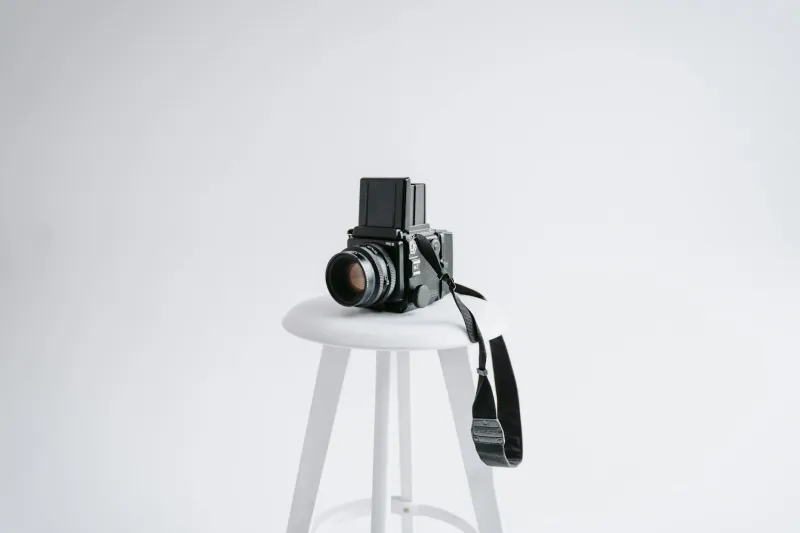
Working with a modified camera system and an assistant who could describe technical settings, Clothier developed what she called "sculptural portraiture." Before each session, she would spend twenty minutes with her hands on her subject's face, reading the topology of their features like a map.
"She would trace my cheekbones, feel the tension in my jaw, even touch the corners of my eyes," recalled Margaret Thornfield, a frequent subject in the 1950s. "It was intimate in a way that felt almost spiritual. She was reading my soul through my skin."
Clothier's technique involved positioning subjects through touch, using her hands to adjust posture, tilt heads, and capture expressions that conventional photographers missed entirely. She could sense when someone was forcing a smile, when shoulders held hidden tension, when eyes—though she couldn't see them—weren't truly engaged.
The Skeptics and the Converts
The New York photography establishment was merciless in its initial reception. Gallery owners dismissed her work as a "novelty act." Critics suggested she was exploiting her disability for attention. One particularly brutal 1952 review called her portraits "technically competent but emotionally hollow—the work of someone who fundamentally doesn't understand the medium."
The criticism stung, but it also revealed something profound: the critics were judging her work by standards that had nothing to do with what she was actually creating.
Clothier's portraits captured something that sighted photographers often missed—the unguarded moments between poses, the micro-expressions that revealed character, the subtle body language that spoke louder than any forced smile. Her subjects looked more like themselves than they ever had in traditional portraits.
The Breakthrough
The turning point came in 1954 when LIFE magazine commissioned Clothier to photograph a series of portraits for a feature on "America's Hidden Stories." The assignment was meant to be a human interest piece about the blind photographer, but the resulting images stopped the magazine's editors in their tracks.
Her portrait of a young civil rights lawyer showed a determination that traditional photographers had somehow missed. Her image of an aging jazz musician captured a weariness and wisdom that seemed to emerge from the shadows themselves. Each photograph felt like a conversation between artist and subject that viewers were privileged to overhear.
"These aren't just photographs," wrote photography critic James Morrison after viewing the LIFE series. "They're archaeological excavations of the human spirit."
The Method Behind the Magic
Clothier's process was painstakingly methodical. She developed a system of spatial memory that allowed her to visualize compositions entirely through touch and sound. She could sense when a room's acoustics suggested the right backdrop, when fabric textures would complement skin tones she couldn't see, when the subtle shift of weight from one foot to another created the perfect asymmetrical balance.
Her darkroom work—conducted with an assistant who served as her eyes—became legendary among photographers. She could direct adjustments to contrast and exposure based on descriptions that most people couldn't even articulate. "Make the shadows in the upper left corner feel heavier," she would instruct. "The light on his forehead needs to whisper, not shout."
Legacy of a Different Vision
By the time of her death in 1978, Clothier had exhibited in over 200 galleries worldwide. Her techniques influenced a generation of photographers who began incorporating tactile elements into their own work. Photography schools started teaching "Clothier methods"—encouraging students to understand their subjects through senses beyond sight.
But perhaps her greatest contribution wasn't technical. In a medium obsessed with the visual, she proved that the most powerful photographs often capture what can't be seen at all—the interior landscape of human experience that reveals itself only when we stop looking and start truly perceiving.
"Vision," she once said in a rare interview, "has very little to do with eyes. It has everything to do with understanding."
The blind photographer who made the world stop and look had shown everyone how to see.