
The Woman Who Couldn't Practice Law
Four times Florence Kelley sat for the bar exam. Four times she failed. By 1891, any reasonable person would have concluded that law wasn't her calling. After all, how do you become a legal reformer when you can't even get licensed to practice law?
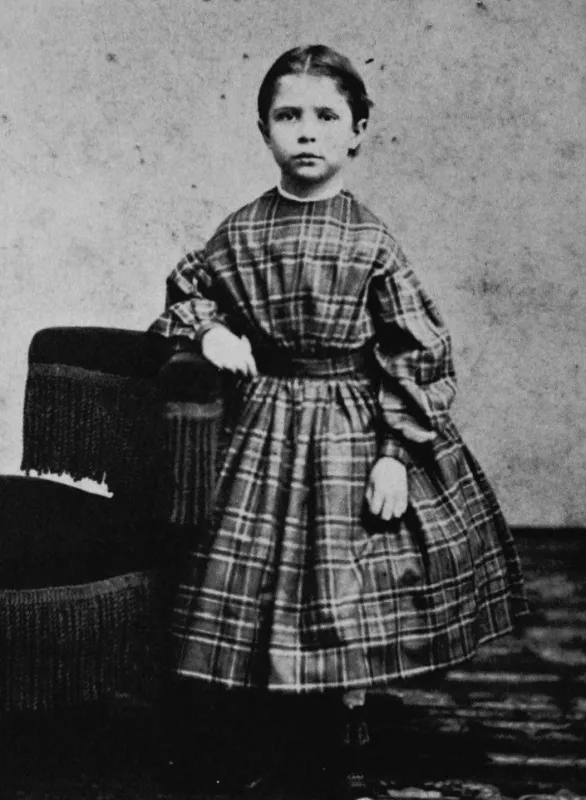 Photo: Florence Kelley, via florencekelley.northwestern.edu
Kelley had a different question: Who says you need a law license to change the law?
Failure as a Feature, Not a Bug
Kelley's repeated bar exam failures weren't just embarrassing—they were financially catastrophic. She'd already fled an abusive marriage in New York, dragging three young children to Chicago with nothing but a suitcase and a Northwestern University law degree that seemed increasingly worthless.
But here's what's remarkable about Kelley's story: those failures forced her to find a completely different route to legal influence. Since she couldn't represent clients, she became something else entirely—a researcher, investigator, and policy architect who would reshape American labor law from the ground up.
Sometimes the door that won't open is saving you from a smaller room.
The Hull House Breakthrough
With no law firm willing to hire a four-time bar exam failure, Kelley found herself at Hull House, Jane Addams' settlement house in Chicago. It was meant to be temporary—a place to regroup while figuring out her next move.
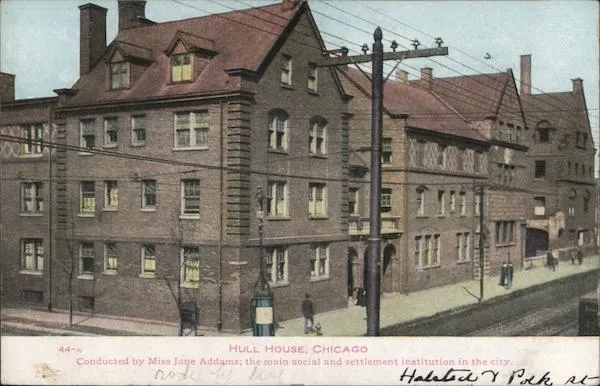 Photo: Hull House, via www.cardcow.com
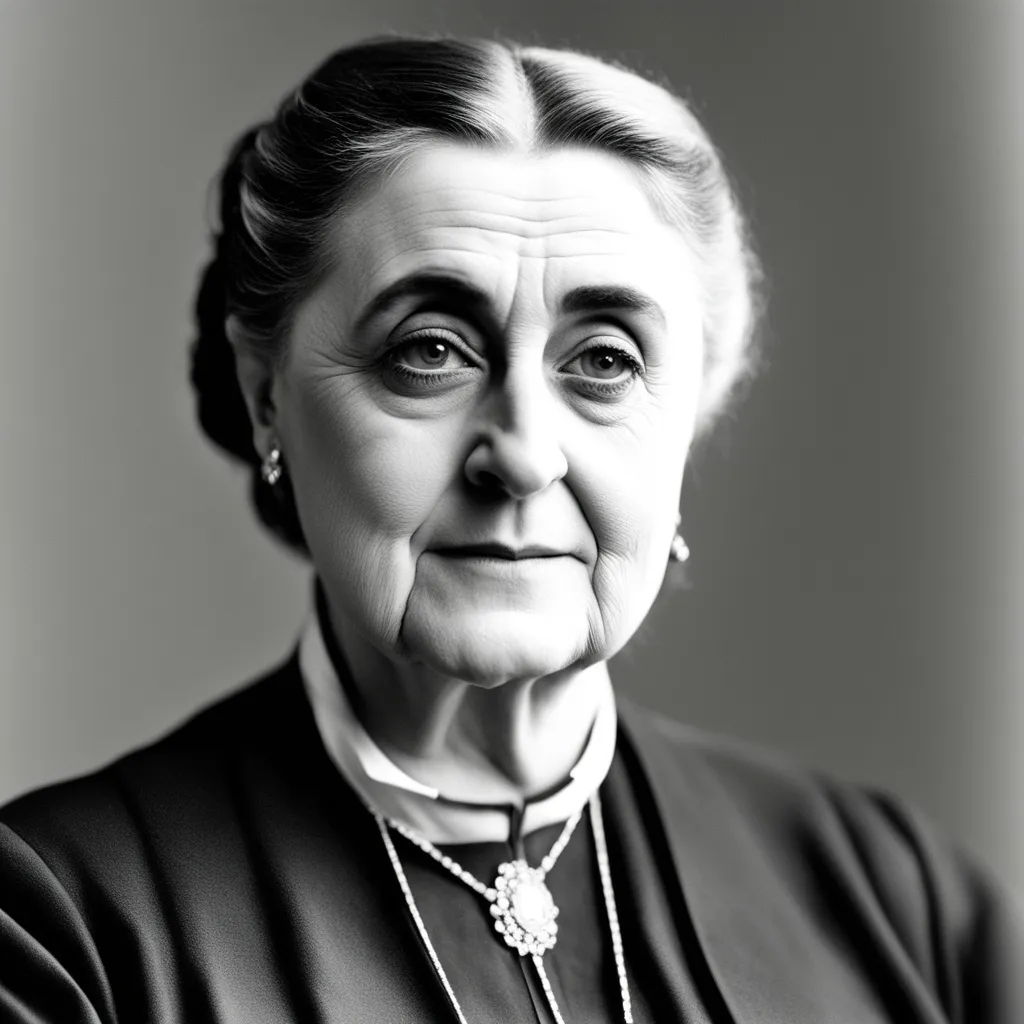 Photo: Jane Addams, via images.deepai.org
Instead, it became her laboratory.
Hull House sat in the middle of Chicago's most brutal industrial district. Kelley found herself surrounded by child laborers, sweatshop workers, and families trapped in conditions that would horrify modern Americans. But while others saw tragedy, Kelley saw data.
She began documenting everything: the ages of child workers, their hours, their wages, their working conditions. She mapped tenement factories, tracked industrial accidents, and built the most comprehensive picture of American labor conditions anyone had ever assembled.
The Strategy That Lawyers Missed
Here's where Kelley's unconventional background became her secret weapon. Traditional lawyers approached labor reform through individual cases—one client, one violation, one small victory at a time. Kelley thought bigger.
She realized that lasting change required legislation, not litigation. And legislation required something lawyers rarely bothered with: bulletproof research that politicians couldn't ignore.
While licensed attorneys argued individual cases, Kelley was building the intellectual foundation for laws that would protect millions of workers simultaneously.
The Illinois Factory Act of 1893
Kelley's breakthrough came when Illinois Governor John Peter Altgeld appointed her as the state's first Chief Factory Inspector—a job that didn't exist until she convinced him to create it.
Suddenly, the woman who couldn't pass the bar exam had more legal authority than most practicing attorneys. She could inspect any factory, issue violations, and shut down operations that violated safety standards.
More importantly, she could gather evidence on an industrial scale.
The Illinois Factory Act of 1893, which Kelley helped draft, was revolutionary: it limited working hours for women, established minimum age requirements for child workers, and created safety standards that became the template for national labor law.
All of this from someone who'd failed the bar exam four times.
Taking It National
By 1899, Kelley had moved to New York as general secretary of the National Consumers League. Her mission: export the Illinois model to every state in America.
Her strategy was brilliant. Instead of fighting individual court battles, she would create consumer pressure that forced companies to improve working conditions. The League published "white lists" of companies that met labor standards and organized boycotts of those that didn't.
Kelley understood something that traditional lawyers missed: in a consumer economy, public pressure often works faster than court orders.
The Supreme Court Argument That Changed Everything
In 1908, Kelley got her chance to argue before the Supreme Court—not as a licensed attorney, but as the architect of the legal strategy in Muller v. Oregon.
The case challenged Oregon's law limiting women's working hours. Traditional legal arguments had failed repeatedly in similar cases. Kelley's approach was different: instead of abstract constitutional theory, she buried the court in data.
The "Brandeis Brief" (named after Louis Brandeis, who presented it) contained over 100 pages of Kelley's research on the health effects of long working hours. It was the first time the Supreme Court had been asked to consider social science evidence in a constitutional case.
They ruled unanimously in favor of the Oregon law.
The Legacy of Legal Failure
Florence Kelley never did pass the bar exam. She died in 1932 without ever being licensed to practice law. Yet her influence on American labor law is impossible to overstate.
The Fair Labor Standards Act of 1938, which established the 40-hour work week and federal minimum wage, was built on foundations Kelley had laid decades earlier. Child labor protections, workplace safety standards, and the very concept of government regulation of working conditions—all trace back to the research and advocacy of a woman who couldn't get a law license.
The Advantage of Outsider Status
Kelley's story reveals something counterintuitive about institutional change: sometimes the most effective reformers are those who can't get inside the institution they're trying to reform.
Because Kelley couldn't practice law traditionally, she had to invent new ways of using legal tools. Because she couldn't represent individual clients, she focused on systemic change. Because she couldn't argue cases in lower courts, she built arguments so comprehensive that they succeeded at the Supreme Court level.
Every American who works a 40-hour week, earns a minimum wage, or sends their children to school instead of factories owes a debt to a woman who failed the bar exam four times. Sometimes the longest odds aren't about getting in the door—they're about building a better door for everyone who comes after you.