
When Darkness Became Light
Leonard Euler was already the most prolific mathematician who ever lived when catastrophe struck in 1766. At 59, the Swiss genius lost sight in his remaining good eye—he'd been blind in one eye since age 28—plunging him into complete darkness. His colleagues assumed his legendary career was over.
 Photo: Leonard Euler, via www.thoughtco.com
They couldn't have been more wrong.
What happened next defied every assumption about human limitation. Rather than retreat, Euler accelerated. In the seventeen years following his blindness, working entirely from memory and dictating to assistants, he produced nearly half of his total life's work—some 400 mathematical papers and several books that would reshape human understanding of the universe.
The numbers alone are staggering. Euler's complete works fill over 80 volumes. If you tried to read everything he wrote at a pace of 60 pages per day, it would take you four years. And remember—almost half of this torrent of genius poured forth in total darkness.
The Mind That Memorized Mathematics
How does someone do advanced calculus without seeing? Euler had spent decades building what amounted to a complete mathematical universe in his head. He could recall the first six powers of every integer up to 100. He knew logarithm tables by heart. Complex formulas that would challenge today's computers lived in his memory like familiar songs.
But this wasn't just memorization—it was mathematical intuition refined to an almost supernatural degree. Euler could "see" mathematical relationships in ways that sighted mathematicians couldn't. His assistant would read him a problem, and Euler would work through entire proofs mentally, dictating solutions that often surprised even himself.
Take his work on the Seven Bridges of Königsberg—a puzzle that had stumped mathematicians for decades. The challenge was to find a path that would cross each of the city's seven bridges exactly once. Working purely in his mind, Euler didn't just solve it; he invented an entirely new branch of mathematics called graph theory that now underlies everything from computer networks to GPS systems.
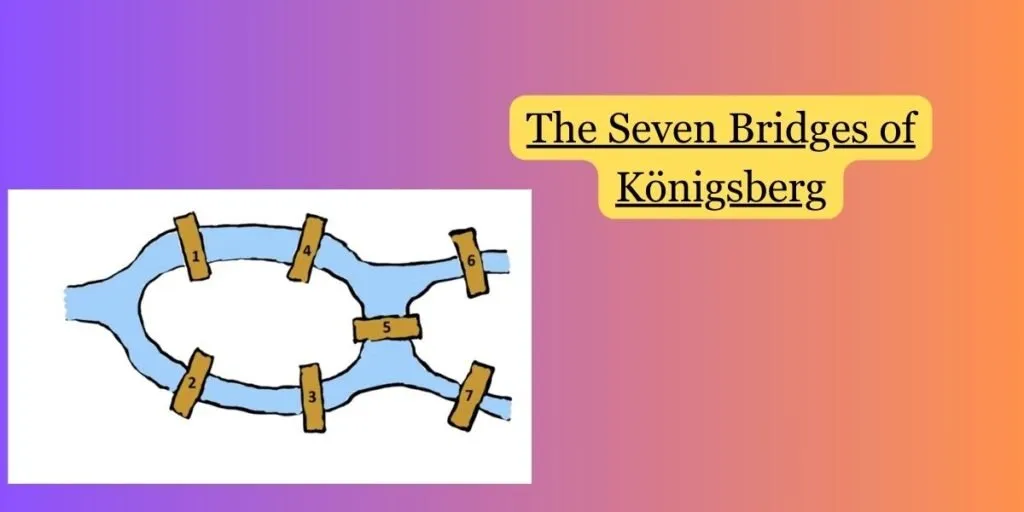 Photo: Seven Bridges of Königsberg, via conceptslab.in
 Photo: Königsberg, via static-3.bitchute.com
The Productive Power of Constraints
Euler's story reveals something profound about human creativity under extreme constraints. Without the distraction of sight, his mind turned completely inward, accessing mathematical truths with a clarity that amazed his contemporaries. His assistants described watching him work as witnessing someone in conversation with invisible spirits of pure mathematics.
He tackled problems that had confounded generations of scholars. His work on infinite series—mathematical expressions that go on forever—laid groundwork that engineers still use to design everything from bridges to smartphones. His insights into fluid dynamics helped explain how blood flows through arteries and how air moves over airplane wings.
Perhaps most remarkably, Euler continued making fundamental discoveries in fields he'd never formally studied. In his 70s, completely blind, he revolutionized the mathematics of music theory, explaining why certain chord progressions sound pleasing to the human ear. He was literally hearing mathematics.
Legacy Written in Darkness
By the time Euler died in 1783—while playing with one of his grandchildren, having just calculated the orbit of a recently discovered balloon—he had fundamentally changed how humans understand space, time, and the hidden mathematical structures that govern reality.
His influence extends far beyond mathematics. Every bridge that stands, every satellite that orbits, every computer that computes relies on principles that Euler developed, many while sitting in darkness, dictating to assistants who could barely keep up with the flood of insights.
The Swiss mathematician's story challenges our deepest assumptions about limitation and possibility. In an age when we're constantly told that physical constraints define our potential, Euler proved that the human mind, properly prepared and passionately engaged, can transcend almost any boundary.
His life suggests that sometimes our greatest breakthroughs come not despite our limitations, but because of them. When external distractions fall away—even through tragedy—the mind can achieve a focus and clarity impossible under normal circumstances.
Euler once said that mathematical truths are like "rays of light in darkness." He spent his final decades proving that sometimes you have to lose your sight to truly see.