The Night Everything Disappeared
On October 8, 1871, Marshall Field stood on the shores of Lake Michigan and watched his entire life's work burn to the ground. The Great Chicago Fire had consumed his dry goods store, his inventory, his building—everything he'd spent fifteen years building.
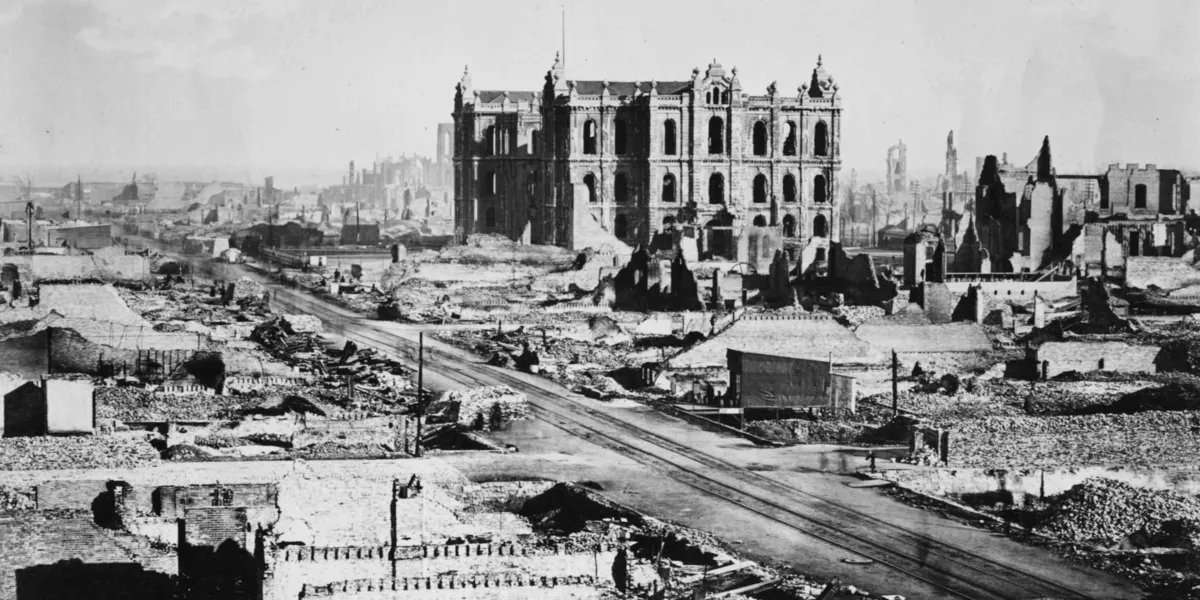 Photo: Great Chicago Fire, via res.cloudinary.com
 Photo: Lake Michigan, via cdn.pixabay.com
At 36, Field was starting over with nothing but debts and a city full of ash.
Most men would have seen the end of their story. Field saw the beginning of something entirely new.
The Merchant Who Thought Different
Before the fire, Field had been a successful but conventional dry goods merchant. His store operated like every other retail establishment in 19th-century America: goods were kept behind counters, prices were negotiated for each transaction, and customers had to ask specifically for what they wanted.
Shopping was a formal, often intimidating process. You needed to know what you wanted before you walked in the door.
The fire changed everything—not just what Field sold, but how he thought about selling.
Building from Absolute Zero
While most Chicago merchants fled to other cities or liquidated their remaining assets, Field made a counterintuitive decision: he would rebuild immediately, in the exact same location.
But this wouldn't be a simple reconstruction. Field had been studying retail innovations from Paris and London, and the complete destruction of his old store gave him something precious—the opportunity to start from scratch with no legacy systems to constrain him.
Within weeks of the fire, Field had leased temporary space and was back in business. But customers who visited expecting the same old dry goods experience found something revolutionary.
The Radical Idea of Fixed Prices
Field's first innovation seems mundane today but was radical in 1871: price tags. Every item in his store had a clearly marked, non-negotiable price.
This was revolutionary. In 1871, retail prices were fluid, negotiated between merchant and customer based on everything from the customer's appearance to their negotiating skills. Shopping was a social performance that many people found stressful and time-consuming.
Field's fixed prices did something unprecedented: they democratized shopping. A working-class immigrant could walk into Field's store and know exactly what everything cost, without having to negotiate or worry about being overcharged.
The Customer is Always Right
Field's second innovation was even more radical: the money-back guarantee. In an era when all sales were final, Field introduced the revolutionary concept that customers could return merchandise if they weren't satisfied.
This wasn't just good customer service—it was a complete reimagining of the relationship between buyer and seller. Field was betting that customer satisfaction was more valuable than the short-term profit from any individual transaction.
The phrase "the customer is always right" is often attributed to Field, and while he may not have coined it, he certainly embodied it. He trained his staff to treat every customer as if their satisfaction was the store's primary concern.
The Birth of the Shopping Experience
But Field's most transformative innovation was spatial: he created the first true "shopping experience" in American retail.
Instead of keeping merchandise behind counters, Field displayed it openly where customers could see, touch, and examine it. He created wide aisles that encouraged browsing. He installed large windows that let in natural light and allowed passersby to see inside.
Most revolutionary of all, he made shopping entertaining. Field's store became a place where customers wanted to spend time, not just complete transactions.
The Economics of Trust
Field's innovations weren't just customer-friendly—they were financially brilliant. By eliminating price negotiation, he could serve more customers in less time. By encouraging browsing, he increased impulse purchases. By guaranteeing satisfaction, he built customer loyalty that translated into repeat business.
But the deeper insight was about trust. In an era when retail was often adversarial—merchants trying to extract maximum profit from suspicious customers—Field created a system based on mutual benefit.
Customers trusted that they were getting fair prices and could return unsatisfactory merchandise. In return, they became not just buyers but advocates who recommended the store to friends and family.
Scaling the Revolution
By 1881, just ten years after the fire, Field's store occupied an entire city block and was generating more revenue than most small cities. But Field wasn't content with local success—he was building a template that would reshape American retail.
Field's methods spread rapidly. Other merchants copied his innovations, and by the 1890s, the "department store" had become a standard feature of American cities. Shopping had evolved from a necessary chore into a leisure activity.
The Unintended Consequences
Field probably didn't set out to transform American consumer culture. He was simply trying to rebuild his business after a catastrophic fire. But his innovations had profound social and economic consequences.
By making shopping more accessible and enjoyable, Field helped create the consumer economy that would define 20th-century America. His emphasis on customer satisfaction and browsing-friendly displays laid the groundwork for everything from suburban malls to online retail.
The modern American relationship with consumption—the idea that shopping can be entertainment, that customer service is a competitive advantage, that retail spaces should be designed for pleasure as well as function—all trace back to innovations Field pioneered while rebuilding from the ashes of the Chicago Fire.
When Disaster Becomes Opportunity
Marshall Field's story isn't just about retail innovation—it's about how complete destruction can become complete freedom. The fire that destroyed his conventional dry goods store liberated him to reimagine what retail could be.
Most entrepreneurs are constrained by existing systems, customer expectations, and incremental thinking. Field got something most innovators never receive: a clean slate and the urgent necessity to rebuild quickly.
Sometimes the longest odds aren't about overcoming obstacles—they're about recognizing when catastrophe has actually cleared the path for something unprecedented. Field lost everything in the Chicago Fire, but what he built from the ashes changed how an entire nation shops, spends, and thinks about the relationship between merchants and customers.
Every time you return an item to a store, check a price tag, or browse through a retail display, you're participating in innovations that emerged from one man's refusal to see a fire as an ending.