She Couldn't Get a Flight School to Take Her. So She Crossed an Ocean and Learned to Fly Anyway.
She Couldn't Get a Flight School to Take Her. So She Crossed an Ocean and Learned to Fly Anyway.
In 1919, if you wanted to learn to fly in the United States and you happened to be Black, or a woman, or — God forbid — both, the answer you received from every flight school in the country was the same: no. Not a reluctant no. Not a come back next year no. A firm, institutional, go-away-and-don't-ask-again no.
Bessie Coleman heard that answer more times than she could count. Then she stopped asking.
A Long Way from Waxahachie
She was born in 1892 in Atlanta, Texas, the tenth of thirteen children. Her father was part Cherokee, her mother Black, and the family eventually settled in Waxahachie — a small town where the cotton fields stretched as far as ambition didn't. She picked cotton as a child. She walked four miles each way to a one-room schoolhouse. She devoured every book she could get her hands on and eventually scraped together enough money to spend a single semester at the Colored Agricultural and Normal University in Oklahoma before the funds ran out and she had to come home.
By her mid-twenties, she was living in Chicago, working as a manicurist in a South Side barbershop, listening to the men around her trade stories about the war in Europe. The pilots who'd come home from the Western Front were the new celebrities of American life — and Bessie Coleman, who had never been inside an airplane, decided she wanted to be one of them.
What happened next is either the most stubborn story in American aviation history or the most inspiring, depending on how you look at it. Probably both.
Every Door in America
She applied to flight schools. She was rejected. She applied again. She was rejected again. The reasons were never complicated — she was Black, she was a woman, and in the eyes of early 1920s American aviation, that combination made her invisible.
It was Robert Abbott, the founder of the Chicago Defender and one of the most influential Black newspaper publishers in the country, who pointed her toward the door nobody had thought to try. Go to France, he told her. The French, who had produced some of the world's first aviators and had a somewhat different relationship with the question of who deserved to fly, might be more receptive.
There was one catch. The flight schools in France taught in French.
Bessie Coleman, who had never left the United States, sat down and taught herself a foreign language. She studied for months. She took a second job. She saved every dollar she could. And in November 1920, she boarded a ship for Europe.
Paris Changes the Math
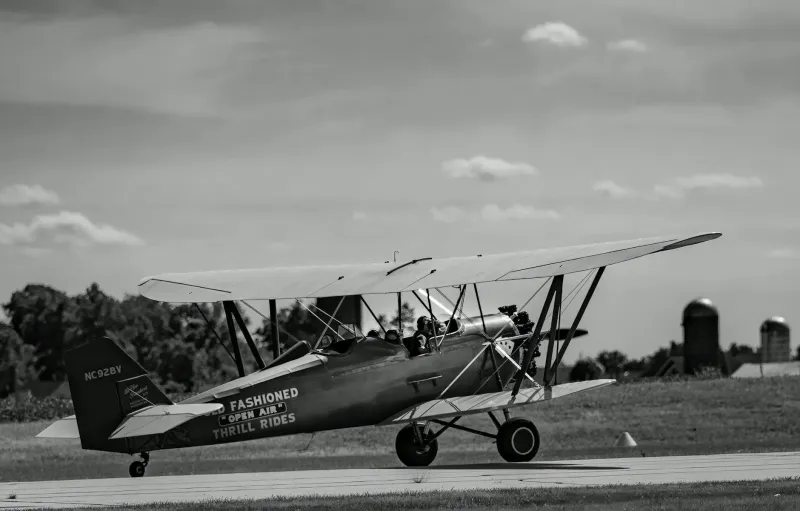
She enrolled at the Fédération Aéronautique Internationale's school in Le Crotoy, Normandy — learning to pilot a Nieuport Type 82 biplane, a notoriously unforgiving aircraft that had already killed two of her fellow students before she earned her wings. She didn't flinch. On June 15, 1921, Bessie Coleman became the first Black woman — and the first Native American woman — to hold an international aviation license.
She was 29 years old. She had started from almost nothing. And she had just done something no American institution had been willing to let her do.
The Barnstormer
She came home to a hero's welcome in the Black press and near-total silence from the mainstream media. Undeterred, she reinvented herself as a barnstormer — performing aerial stunts at air shows across the South and Midwest, drawing enormous crowds, and becoming one of the most recognizable figures in Black American life during the early 1920s.
She was strategic about it, too. She refused to perform at venues that wouldn't allow Black attendees to enter through the same gate as white spectators. In the Jim Crow South, that wasn't a small demand. She made it anyway.
Her larger dream was to open a flight school — a place where Black Americans could learn to fly without sailing across the Atlantic to do it. She was still working toward that goal on April 30, 1926, when a mechanical failure during a rehearsal flight over Jacksonville, Florida, sent her aircraft into a fatal dive. She was 34.
What She Left Behind
The flight school never got built — not by her, anyway. But the pilots she inspired did the work she'd mapped out. Cornelius Coffey and John Robinson, two of the men who cited Coleman as their reason for entering aviation, went on to train the pilots who became the Tuskegee Airmen. The chain of audacity she started in a Chicago barbershop ran all the way to World War II.
In 1995, the U.S. Postal Service put her face on a stamp. The city of Chicago named a street after her. A group of Black female pilots still flies over her grave in Fort Worth every year on the anniversary of her death, dropping flowers from the air.
The long odds she faced were real. The institutions that tried to stop her were real. But so was the license she earned in France, the crowds she drew, and the lives she changed. Bessie Coleman didn't wait for the doors to open. She found a different building entirely.