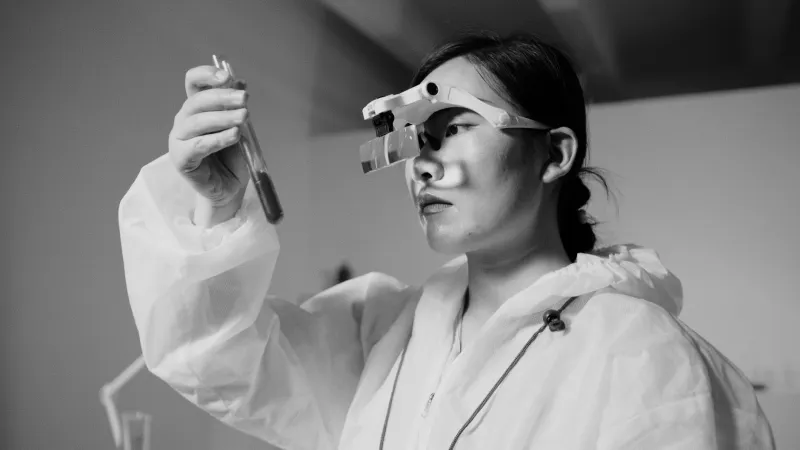
The Twenty-Three-Year-Old Who Cracked an Ancient Disease
In 1915, Alice Ball was just a graduate student at the University of Hawaii, the first African American and first woman to earn a master's degree in chemistry there. While her classmates focused on theoretical problems, Ball chose to tackle something that had stumped medical science for centuries: leprosy.
For thousands of years, leprosy had been a death sentence wrapped in social exile. Victims were shipped to remote colonies like Molokai in Hawaii, where they waited to die in isolation. The only treatments available were painful, ineffective, and often killed patients faster than the disease itself.
Ball had a different idea. Working alone in her laboratory—many facilities still barred women and minorities—she began experimenting with chaulmoogra oil, a traditional remedy from the chaulmoogra tree. Previous scientists had tried using the oil directly, but it was too thick to inject and too nauseating to swallow in effective doses.
Ball's breakthrough was elegant in its simplicity: she figured out how to isolate the oil's active compounds and make them water-soluble. Suddenly, doctors could inject effective doses directly into patients' bloodstreams. The results were miraculous.
A Treatment That Changed Everything
By 1916, Ball had developed what became known as the "Ball Method"—though she never got to call it that. Her ethyl ester derivatives of chaulmoogra oil became the first successful treatment for leprosy, offering hope to millions worldwide.
Patients who had been written off as terminal began recovering. At Kalaupapa, the infamous leper colony on Molokai, people started returning home to their families for the first time in decades. The treatment was so effective that it remained the standard therapy for leprosy until antibiotics were developed in the 1940s.
But Alice Ball never saw her triumph. In December 1916, at just 24 years old, she died suddenly—possibly from accidental chlorine poisoning while conducting research. Her thesis advisor, Arthur Dean, stepped in to "complete" her work.
The Great Theft
What happened next was one of the most shameful episodes in scientific history. Dean took Ball's research, published it under his own name, and spent decades accepting credit for the breakthrough. He called it the "Dean Method" and never once mentioned his deceased student's contributions.
The medical establishment embraced Dean's version of events. He received honors, speaking engagements, and lucrative consulting contracts. Meanwhile, Alice Ball's name vanished from scientific literature. For seventy years, one of the most important medical breakthroughs of the early 20th century was attributed to a man who had simply stolen a young woman's work.
The theft was particularly cruel because Ball had been so close to completing her research. Her laboratory notebooks, discovered decades later, showed she had essentially solved the leprosy problem months before her death. Dean had merely finished documenting her discoveries.
The Long Fight for Recognition
Alice Ball might have remained forgotten forever if not for Dr. Kathryn Takara, a historian at the University of Hawaii who stumbled across Ball's story in the 1970s. Takara was researching early African American scientists when she found references to a mysterious "A. Ball" in medical journals from the 1910s.
Digging deeper, Takara uncovered the truth: not only had Ball developed the leprosy treatment, but she had been systematically erased from the record. Dean's published papers contained large sections lifted directly from Ball's thesis, often word-for-word.
Takara launched a campaign to restore Ball's legacy, but it took decades to gain traction. The medical establishment was reluctant to admit that one of its celebrated breakthroughs had been built on plagiarism. It wasn't until 2000—84 years after Ball's death—that the University of Hawaii officially honored her contributions with a plaque and scholarship fund.
Hidden Figures Everywhere
Ball's story raises uncomfortable questions about how many other discoveries have been stolen, particularly from women and minorities who lacked the social power to defend their work. In the early 1900s, academic and medical institutions were overwhelmingly white and male. Young researchers like Ball had little recourse when their work was appropriated.
Consider the timing: Ball made her breakthrough during World War I, when scientific advances were desperately needed but credit often went to whoever could claim it most convincingly. How many other Alice Balls were written out of history during this period?
Today, Ball's method is recognized as a pivotal moment in medical history. Her approach to making chaulmoogra oil injectable influenced drug delivery systems that are still used in modern medicine. Some historians argue that her work laid groundwork for later breakthroughs in treating other infectious diseases.
The Price of Being First
Alice Ball's story is ultimately about more than stolen credit—it's about the hidden cost of being a pioneer. As the first African American woman in her field, she had no mentors who looked like her, no network to protect her interests, and no institutional support when her work was appropriated.
Yet her scientific method was so sound that it saved thousands of lives and remained the standard treatment for decades. The elegance of her solution—making an ancient remedy compatible with modern medicine—showed an intuitive understanding of chemistry that impressed even her detractors.
Today, the University of Hawaii's medical school has a scholarship named for Alice Ball, and February 29th is officially "Alice Ball Day" in Hawaii. It's a small recognition for someone whose work changed the world, but at least her name is finally attached to her discoveries.
Sometimes the long odds aren't just about achieving something remarkable—they're about getting credit for it too.